The Shelf Between Two Tongues: British Arab Novelists Writing in English
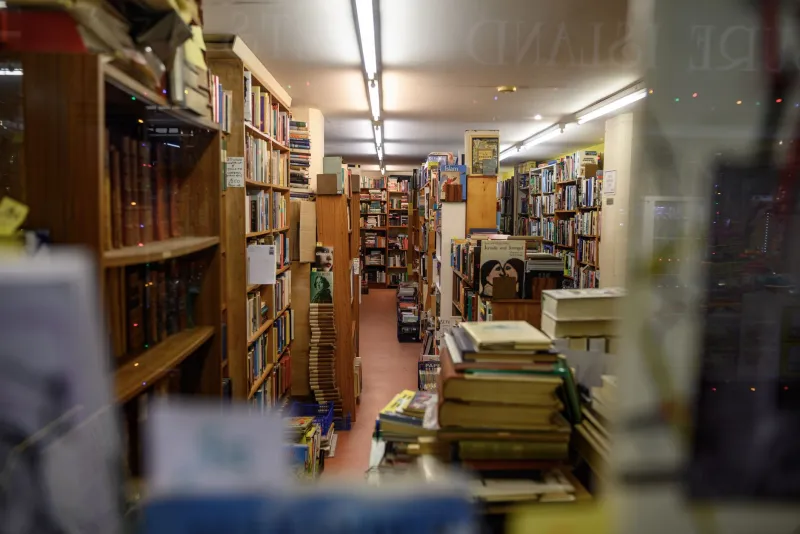
Walk into a big British bookshop and ask where the Arabic fiction lives. You’ll be pointed at a table of translated novels — Egyptian, Lebanese, Iraqi, Palestinian — with the translator’s name in small type on the spine. Now ask the same question about a novel by a British writer of Arab heritage, written in English. You’ll usually get a pause. Then: general fiction. Or ‘British novels’. Or that catch-all shelf, ‘world fiction’, where anything with a foot in two places tends to end up.
That pause is the subject of this piece. Over the last three decades, a real body of work has built up: British Arab novelists who write in English, publish in London or Edinburgh, give readings in Manchester and Cardiff, and yet sit awkwardly in a category designed for books that arrived in English by translation. The work is here. The shelf hasn’t caught up.
The wave that doesn’t fit the label
The names are not obscure. Ahdaf Soueif, born in Cairo and long resident in London, whose The Map of Love was shortlisted for the Booker Prize in 1999 — still the most high-profile example of a British Arab novel getting the full UK prize treatment. Leila Aboulela, Sudanese-Scottish, whose fiction has moved between Aberdeen, Khartoum and the Highlands. Jamal Mahjoub, born in London, raised in Sudan and Egypt, published here for decades. Fadia Faqir, Jordanian-British, whose My Name Is Salma put an Arab protagonist in Exeter. Robin Yassin-Kassab, British-Syrian, whose The Road from Damascus appeared in 2008. Selma Dabbagh, Palestinian-British, author of Out of It. Nada Awar Jarrar, Lebanese, long a London resident. And, more recently, Isabella Hammad, British-Palestinian, whose The Parisian won the Sue Kaufman Prize in 2020 and whose Enter Ghost has become a book-group staple on both sides of the Atlantic.
All of them write in English. All of them are, in some sense, Arab novelists. None of them fit neatly into the translated-fiction section that British shops use as shorthand for ‘Arabic literature’.
Why the category cracks
There is a structural reason for this. The International Prize for Arabic Fiction — the biggest award in Arabic letters, run with the Booker Prize Foundation — requires that a submitted novel be published in Arabic. A novel composed in English, however Arab its concerns and however Arab its author’s family, is simply outside its remit. The Saif Ghobash Banipal Prize, meanwhile, rewards translation into English, so it honours the translator rather than the English-language novelist.
On the UK side, the same books are read as British fiction, which is accurate, but the Arab half of the identity tends to get dropped in the marketing. A jacket will say ‘a sweeping story of love and empire’, not ‘a novel of the Arab diaspora’. Then a reader who came in looking for Arabic fiction doesn’t find it, and a reader who came in looking for British fiction doesn’t realise what they’re holding.
None of this is anyone’s fault exactly. But it does mean that the phrase ‘Arabic fiction’ in a British bookshop almost always means ‘fiction translated from Arabic’, and that is a narrower thing than it sounds.
Six novels for a shelf that holds both
If you want to read across the gap, start here. These aren’t ranked, and they aren’t a canon.
Isabella Hammad, Enter Ghost (2023). A London-based actor goes to the West Bank to stage Hamlet; the novel is as much about rehearsal rooms and family silences as it is about politics. A good pairing with any translated Palestinian novel, and a useful reminder that the diaspora writes back in English.
Leila Aboulela, Bird Summons (2019). Three women drive to the Scottish Highlands to visit the grave of a Victorian convert. There’s a talking hoopoe. It’s funny, odd and very British in its landscapes, and it does something translated fiction rarely gets to do: put faith and humour in the same car.
Ahdaf Soueif, The Map of Love (1999). The Booker-shortlisted one. Dual timeline, Cairo and London, a Victorian widow and a modern-day descendant. If you only read one book from this list, this is the one that explains why the rest exist.
Fadia Faqir, My Name Is Salma (2007). A young woman flees a family honour killing in Lebanon and ends up in Exeter, working in a care home. The West Country setting is not a gimmick; it’s the point. Displacement is not only a London story.
Jamal Mahjoub, Travelling with Djinns (2003). A road novel across Europe, a father and son, a mixed heritage that won’t resolve itself. Mahjoub is one of the most consistently interesting British Arab novelists and one of the least shelved in the right place.
Robin Yassin-Kassab, The Road from Damascus (2008). A London bookshop-owner’s son, a convert, a city under pressure. Blunt, funny, and much more interested in doubt than in certainty.
If you want a seventh, take Selma Dabbagh’s Out of It, which moves between London and the Gulf and is one of the best British novels of the last fifteen years about not quite belonging anywhere.
Two languages, one shelf
The practical question is what to do with all this. A few suggestions.
Pair your reading. For every translated Arabic novel you buy, buy one English-language novel by a British Arab writer. They illuminate each other, and the pairing makes the artificiality of the category obvious.
Ask for both. If your local library or bookshop has an ‘Arabic fiction’ section, ask whether it includes English-language diaspora writing. If it doesn’t, ask why. Booksellers are usually glad to be asked; the category is fuzzy for them too.
Read the small print. Check whether a book was written in Arabic or in English, and notice the translator’s name when there is one. It changes how you read.
Don’t rank. There’s a temptation to treat translation as more authentic and diaspora writing as diluted. That’s nonsense. A novel written in English by a writer who grew up between two languages is not a lesser version of an Arabic novel; it’s a different kind of Arabic novel, and a British one.
The shelf, in the end, is not a border. It’s a corridor. You can walk down it in either direction, and the books will still be there when you turn round.