Follow the Colophon: A Reader’s Map of the UK Presses Publishing Arabic Fiction
Most readers navigate a bookshop by author, genre or cover. That is sensible, but it leaves a useful clue on the table: the colophon. The little logo at the bottom of the spine tells you who made the book, and in Arabic fiction in English it tells you quite a lot. A handful of UK presses do most of the heavy lifting, and each has a personality. Learn four or five of them and you have something close to a recommendation engine.
This is not a ranking. It is a map, drawn for readers in Britain who want to move beyond the single Arabic novel that happened to get a broadsheet review. The map is smaller than you might expect, and that is part of the point.
Start with the old guard
Saqi Books is the closest thing the UK has to a one-stop Arabic fiction shelf. Its list ranges across modern novels, history, politics and memoir, and it has been doing this for long enough that its backlist functions as a kind of informal canon. If you see Saqi on the spine, expect a book that takes the Arab world seriously as a literary space rather than as a news story with characters. The list is broad, sometimes argumentative, and often strongest when a novel sits at the junction of family history and national history.
Darf Publishers has a similarly long memory. Its list leans towards modern Arabic fiction, classics in translation and historical writing, with an eye for books that might otherwise vanish from English-language view. Darf is not as noisy as some larger imprints, but its presence matters: it keeps older and less fashionable titles in circulation. For a reader trying to understand the depth of Arabic fiction rather than just the current wave, that is valuable.
Banipal Books grows out of Banipal magazine, and you can feel that in the list. It is literary in the serious sense: short stories, poetry, novels that reward patience, and an ongoing commitment to translators as writers in their own right. If a Banipal book catches your eye, expect craft and context. It is the imprint equivalent of a quiet bookseller who presses a book into your hand and says, try this one, it is better than it looks.
The translation-forward indies
Then there are the presses that are not Arabic specialists but publish translated fiction with real conviction. Fitzcarraldo Editions and And Other Stories are the obvious examples. Their Arabic titles appear selectively, which is exactly why they are useful: when they take on a translated novel, they tend to place it in the general fiction conversation rather than on a curiosity shelf. You are not being sold a window into another culture. You are being sold a novel.
Comma Press occupies a different corner. Its short-story anthologies often bring together writers from a particular city or region, and Arabic-language writers appear in that mix. If you like the short story as a form, Comma is a good colophon to follow because it treats translation as part of the editorial architecture, not an afterthought. These books are also useful for reading groups: short, varied, and easy to dip into without losing the thread.
The translation-forward indies do one thing especially well: they normalise Arabic fiction. A reader who picks up a Fitzcarraldo or And Other Stories title may not even register that the book began in Arabic until the translator’s note. That is not a failure of visibility. It is a sign that the book has been allowed to be literature first.
The micro-imprints and the direct-order reality
The newer micro-imprints are harder to map because they move. Some run on subscriptions, some on crowdfunding, some on festival tables and a single enthusiastic editor. They often publish poetry, essays, short fiction and hybrid work that larger presses cannot make pay. Their print runs are small, their websites are sometimes plain, and their books can disappear quickly. But they are where some of the most interesting translation work happens.
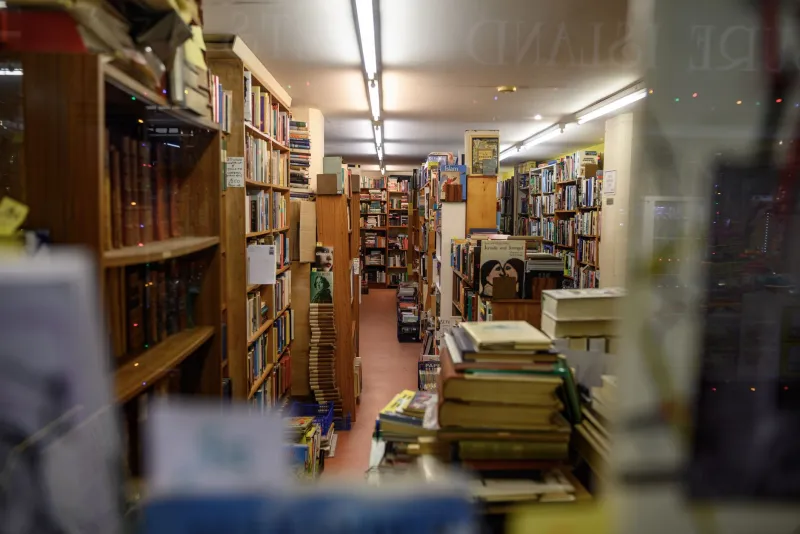
This is also where the high-street reality bites. A chain bookshop will usually carry a handful of Arabic novels in translation: a prizewinner, a Penguin Classics title, perhaps a Saqi book if the branch is feeling generous. You will not often find a dedicated Arabic fiction bay. Independent bookshops are better at ordering, and a good bookseller can find most in-print titles if you give them the publisher and the translator. But the backlist often lives online, on the publisher’s own site or through direct order.
That is not a reason to avoid shops. It is a reason to ask. If a book is not on the shelf, the shop can usually order it. If it is from a micro-imprint, ordering direct may be the only reliable route. Either way, the colophon is your friend: it tells you who to ask for.
How to read a colophon
Start with the publisher, then check the translator. A press with a strong translation list will usually name the translator prominently, and that name is another recommendation engine. Look at whether the book is part of a series. Series are editorial arguments: they tell you what the publisher thinks belongs together. If you like one book in a series, the next one is a reasonable gamble.
It also helps to notice what a press does not do. A list that is strong on historical novels may be thin on contemporary comedy. A poetry-led imprint may publish fiction only occasionally. That is not a flaw. It is a profile. Reading by imprint means reading with a sense of profile rather than treating every translated novel as interchangeable.
If you liked this, try this
- If you liked a Saqi historical novel, try Darf for an older or less obvious Arabic classic in translation.
- If you liked a Banipal short story, try a Comma Press anthology that mixes Arabic-language writers with other translated voices.
- If you liked a Fitzcarraldo novel in translation, try And Other Stories for another selective international list with a similar seriousness about form.
- If you liked a prizewinner you found in a chain bookshop, order the publisher’s backlist direct and see what else they thought was worth translating.
- If you liked an anthology, follow the translator. They often have a taste that runs across presses.
The map is small, but it is usable
Arabic fiction in Britain is not yet a vast shelf. It is a cluster of committed publishers, a few translation-forward indies and a shifting set of micro-imprints. That can feel fragile, but it is also navigable. You do not need to know every title. You need to know a few colophons, a few translators and the difference between what a chain shop stocks and what a publisher can send you.
Treat the imprint like a bookseller’s tip. It will not always be right, but it will often be interesting. And in a field this small, interesting is a good place to start.