Somebody Gave This Away: Arabic Fiction's Afterlife in British Charity Shops
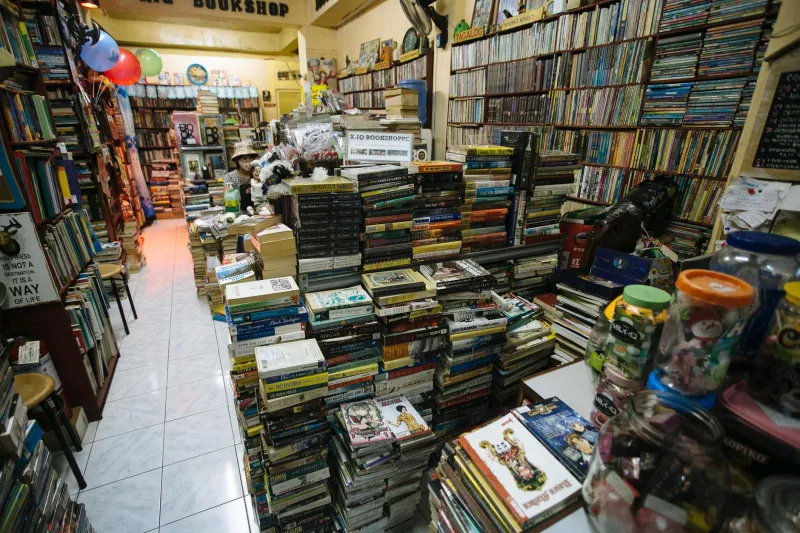
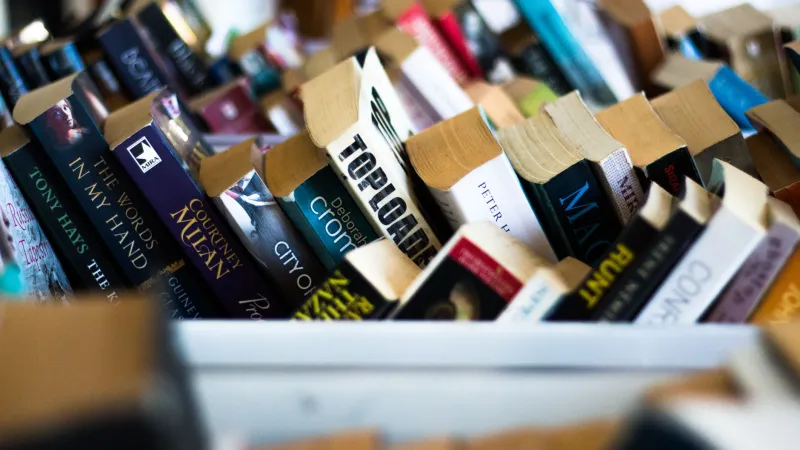
The first thing you notice is not the absence but the repetition. In a Scope on Kirkstall Road in Leeds, there were two copies of The Yacoubian Building leaning against each other like commuters on a delayed train, a sun-bleached Season of Migration to the North with a cracked spine, and a hardback of The Map of Love priced at £2.50. None of them looked like they had been read recently. All of them had clearly been bought by somebody, once, with intent.
That is the strange gift of the charity-shop shelf. It is not a canon. It is a census of what British readers actually bought, finished, abandoned, inherited, or politely offloaded after a house move. For Arabic fiction in English, the pre-loved pile is a more honest record of staying power than any review section. It tells you which translated novels travelled beyond the publicity cycle and which ones never made it past the first owner's bedside table.
The shelf that doesn't review books
Charity shops do not select stock the way bookshops do. They receive it. A volunteer in Bristol described the process to me as 'a conveyor belt of other people's decisions' — boxes from house clearances, bags from students leaving halls, the occasional complete collection of a reader who has died and whose family is doing the necessary, painful work of dispersal. The result is a shelf shaped by grief, downsizing, taste and chance rather than by marketing budgets.
That makes it a useful place to think about what lasts. A novel that appears in every British Heart Foundation window from Norwich to Cardiff has usually done something right: it was readable, it was affordable, it was recommended by a friend, or it was set on a course. A novel that never appears at all may be brilliant, but it may also have been printed in small numbers, priced too high, or reviewed in places that its potential readers never saw.
The charity-shop shelf is a lagging indicator, not a verdict. But lagging indicators are often the most revealing ones.
What actually turns up
In Glasgow, a bookseller who runs a second-hand stall in a church hall told me that Arabic fiction arrives in waves. 'You get the Mahfouz years,' he said, meaning the period when every household seemed to contain a copy of Midaq Alley or the Cairo Trilogy, usually in the old Anchor or Penguin editions. Then you get the Alaa Al Aswany bump: The Yacoubian Building is probably the single most common translated Arabic novel I have seen in charity shops, partly because it was a word-of-mouth hit and partly because it is the kind of book that gets bought for a book club and then quietly returned to the wild.
Hanan al-Shaykh turns up often, especially The Story of Zahra and Women of Sand and Myrrh. Ahdaf Soueif's The Map of Love is everywhere in the kind of shop that has a 'literary fiction' shelf, though it is worth remembering that Soueif writes in English rather than being a translated writer. Elias Khoury's Gate of the Sun appears less often, but when it does it tends to be the Archipelago edition, thick and serious and usually in better condition than you expect. Mahmoud Darwish's poetry shows up in slim, hopeful-looking volumes that someone bought after a festival and then found too difficult to read on the bus.
The pattern is not random. Short novels survive. Books with film adaptations survive. Books with clear, human stories and attractive covers survive. Books that require a glossary and a quiet week tend to end up in the 50p box outside the door.
Why some writers stay and others don't
A volunteer in Leeds put it more bluntly: 'We can sell Mahfouz all day. We can't give away the experimental stuff.' That is not a literary judgement, and it is not a reason to avoid the experimental stuff. It is a description of how charity-shop economics work. Shelf space is limited, volunteers are busy, and a book that has sat for three weeks is likely to be moved to the cheap table.
But there are other reasons a writer stays on the shelf. Penguin Modern Classics and Penguin Classics give a book a recognisable spine and a certain promise of quality. AUC Press editions, especially the older ones, signal a serious translation. A cover that looks like a novel rather than a textbook helps. So does a translator's name on the front: Denys Johnson-Davies, Humphrey Davies, Marilyn Booth, Roger Allen, Leri Price, Jonathan Wright, Sinan Antoon. These names do not guarantee a good read, but they do suggest that somebody cared about the English sentence as well as the Arabic one.
The books that disappear fastest are often the ones that were never framed as 'Arabic fiction' in the first place. The Yacoubian Building is a downtown Cairo ensemble novel with a gay narrator, a corrupt businessman and a lot of sex. The Map of Love is a historical romance with a Booker shortlist behind it. Season of Migration to the North is short, strange and teachable. Readers do not need a category to pick them up. They need a reason.
A bookseller's rule of thumb
A second-hand bookseller in Bristol, who has been sorting donated stock for more than a decade, gave me a simple test. 'Look at the spine first,' she said. 'If it says "translated by" and not "retold by", you're probably fine. If it says "adapted for young readers", put it back unless you want a school text. If it says "with an introduction by" and the introduction is longer than the novel, be suspicious.'
She also suggested checking the publication date. Older editions are not automatically worse, but translations age. A 1980s translation of a 1960s novel may still be the only one available, and that is fine. A 2020s reprint with a new translator is worth paying a little more for. Charity shops rarely price according to scarcity, so a good edition can slip through for £1.50 while a tatty book-club copy sits next to it at £3.
How to spot a good edition in the pile
Here is a practical checklist for the next church-hall stall or charity-shop shelf:
- Check the publisher. AUC Press, Penguin Modern Classics, Archipelago, Pushkin Press, MacLehose, Fitzcarraldo, Telegram, Saqi and Garnet are all worth a second look. So are older Bloomsbury and Quartet editions, though condition varies wildly.
- Find the translator. It should be on the title page, not just in the small print. A named translator is a good sign. 'Translated from the Arabic by' is better than 'English version by'.
- Look for the original title. If the English title is completely different and there is no note about the Arabic original, it may be an adaptation or a retelling rather than a translation.
- Check for abridgements. Children's editions, 'simplified' readers and film tie-ins are not necessarily bad, but they are not the novel. If you want the novel, check the page count against a newer edition on your phone.
- Inspect the spine and the first page. A cracked spine is fine if the text is clean. Water damage, missing maps and heavy pencil notes are not worth £4. Charity shops are cheap for a reason, but they are not free.
- Compare prices. A £2 charity-shop copy of a book that retails at £10 is a bargain. A £6 ex-library copy of the same book is not, unless it is out of print.
The overlooked titles worth rescuing
Some of the best finds are the ones that never became bestsellers. Sonallah Ibrahim's That Smell and Notes from Prison turn up in thin, serious editions that look like pamphlets and read like a slap. Hoda Barakat's The Stone of Laughter and The Tiller of Waters are harder to find but worth grabbing when they appear. Ibrahim al-Koni's The Bleeding of the Stone is a desert novel that reads like a fable and deserves a much wider UK readership. Abdelrahman Munif's Cities of Salt is a big, angry book that charity shops sometimes price at £2 simply because they do not know what to do with it.
Also keep an eye out for Ghassan Kanafani's Men in the Sun, Emile Habibi's The Secret Life of Saeed the Pessoptimist, Radwa Ashour's Granada, and Ahlam Mosteghanemi's Memory in the Flesh. None of these are guaranteed to be there. But when they are, they tend to be cheap, and they tend to be good.
What the pre-loved pile is telling publishers
The second-hand shelf is not a graveyard. It is a distribution network with a very low price point and a very long tail. Books that did not sell well in 2019 can still find readers in 2026 for £1.50 in a Sheffield hospice shop. That is not a failure. It is a second life.
But it is also a warning. If the same five Arabic novels appear in every charity shop in the country, and the rest never appear at all, then the UK market is not really a market. It is a small, repeated loop. The pre-loved pile shows which books broke out of that loop and which ones are still waiting for a reader who does not yet know they exist.
Next time you are in a charity shop, look at the spine. Look for the translator. Look for the publisher. You might find a novel that somebody gave away, and that you will be very glad to keep.