The Handwritten Card in the Cookbook: Arabic Food Writing for British Kitchens
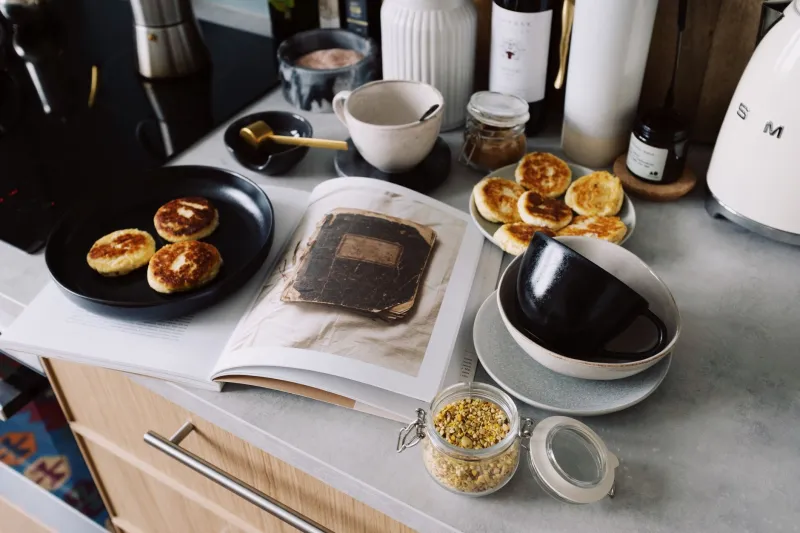
A recipe is rarely just a list. It is a voice at the stove, a shopping list with a history, a set of measurements that assumes you already know what the finished dish should smell like. That is especially true of Arabic cookbooks published for English-speaking kitchens. In 2026, the range available to UK readers is wider than it has ever been, but the best of them still feel like they have been passed across a table rather than posted through a letterbox.
The side door into Arabic literature
Food writing has a way of getting readers past the usual gatekeepers. A British reader who might hesitate before picking up a translated novel will happily buy a cookbook with a photograph of maqluba on the cover. That is not a failure of literary curiosity. It is often the beginning of it. Cookbooks sit in the same part of a bookshop as memoir and travel writing, and they carry the same basic promise: come into someone else's kitchen and stay for a while.
That promise matters for Arab literature in the UK. A cookbook can introduce a place through its pantry before a novel introduces it through its politics. It can make a reader familiar with the sound of a family name, the geography of a village, the particular way a grandmother insists on soaking rice. By the time that reader picks up a novel by an Arab writer, the sensory groundwork has already been laid.
What changes when a dish crosses into English
Translation is not only a literary problem. It is a kitchen problem too. When a recipe moves into English, someone has to decide whether to call it za'atar or a spice blend, whether to specify freekeh or suggest bulgur, whether a 'cup' means a British mug, an American measuring cup or the glass that was nearest the sink. Oven temperatures have to be converted. Cuts of meat have to be explained. Ingredients have to be made findable in a Waitrose, a local Asian supermarket or an online order that arrives on a Tuesday.
Something is always lost in that move. The hand that knew how much water to add. The sound of the pot. The auntie who never measured anything and whose food was better for it. What is found, though, is access. A clear recipe can take a dish that felt intimidating and make it ordinary, repeatable, part of a British weeknight. That is not a small thing. It is how a cuisine stops being exotic and starts being dinner.
The historical cookbooks make this especially clear. The Sultan's Feast: A Fifteenth-Century Egyptian Cookbook, translated by Daniel L. Newman, and the older Baghdad cookery manuscripts collected in English translation are fascinating precisely because they are not written for modern shoppers. They need notes, context and a bit of patience. They remind you that a recipe is a document, not just a set of instructions.
Six books worth clearing space for
Falastin by Sami Tamimi and Tara Wigley is the obvious place to start, and obvious is not a bad thing. It is generous, practical and full of dishes that work in a British kitchen without pretending the kitchen is somewhere else. The chapter on pantry staples alone earns its place.
The Palestinian Table by Reem Kassis is more intimate. It moves between family history and home cooking, and the recipes are written with the kind of detail that assumes you might actually make them on a Sunday. It is a book about a table as much as it is about food.
Zaitoun by Yasmin Khan is a travel book with recipes attached, which is a compliment. It follows olive harvests and family kitchens, and it makes Palestinian food feel both specific and welcoming. If you want a cookbook that reads like a narrative, start here.
The Lebanese Cookbook by Salma Hage is a big, reliable volume for anyone who wants a broad repertoire: mezze, stews, rice dishes, sweets. It is the sort of book you keep on the shelf and reach for without thinking.
The Arabesque Table by Reem Kassis is a good next step. It takes familiar ingredients and pushes them in different directions, and it is particularly useful for cooks who want to understand how a dish travels across borders rather than staying fixed in one national tradition.
Finally, keep a copy of Claudia Roden's A New Book of Middle Eastern Food nearby. It is not strictly an Arabic cookbook in the narrowest sense, but it has been a gateway for British cooks since the late 1960s, and its influence is impossible to ignore.
Shopping without flattening the dish
A good Arabic cookbook will tell you what to do when you cannot find exactly the right thing. UK readers are lucky here: Middle Eastern and Asian grocers in London, Birmingham, Manchester and Leicester carry most of what these books ask for, and online suppliers have made the rest easier to find. But substitution is not the same as erasure. If a recipe calls for pomegranate molasses, don't reach for balsamic vinegar and call it a day. If it asks for dried lime, the whole point of the dish may be that sour, dusty note.
The other rule is simpler: read the headnotes. In Arabic food writing, the headnote is often where the memory lives. It tells you why the dish matters, who made it and what it is for. Skipping straight to the ingredients is like reading a novel for the plot summary.
The shelf after dinner
Cookbooks are not a lesser form of Arabic literature. They are part of it. They carry family history, migration, place and the small daily decisions that make a culture legible. A British reader who starts with a recipe for fattoush may end up looking for a novel about displacement, a memoir about exile or a poetry collection about a city they have never visited. That is how shelves grow. One dish at a time.