Second Billing: Why the Translator's Name Is Still an Afterthought on UK Jackets
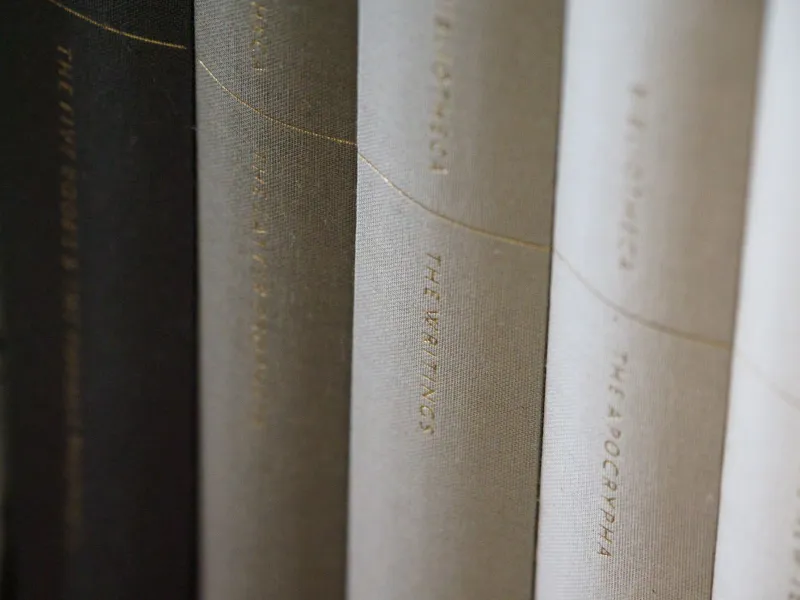
Stand in any branch of Waterstones with a new Arabic novel in your hand and play a small game: find the translator's name before the till finds you. Sometimes it is on the cover, in type you could read from a metre away. More often it is on the title page, or the copyright page, or the back cover just above the barcode, in a font that seems designed to be missed. The author's name is 36-point. The translator's is nine.
The typography of credit
Typography is never neutral. A name set large says: this is the person you are here for. A name set small says: this is admin. When a UK publisher puts the translator's name below the title in six-point italic, it is making an argument about where the book comes from. The argument is that the novel arrived fully formed, in English, and that the person who made the English is a detail — a bit like the printer, or the paper supplier.
The Arabic original is a different object. It does not carry a translator's name, because there is no translator yet. It carries the author, the title, sometimes a publisher's colophon and a line of poetry. The book is not a translation; it is a book. The English edition is a meeting, and the jacket is the only place where that meeting is publicly recorded. When the translator's name is buried, the jacket tells a small lie: that the novel crossed the language by itself.
Three editions, three approaches
On my own shelf, the pattern is easy to see. A Fitzcarraldo paperback of an Arabic novel gives the translator the cover, in modest but legible type. A Penguin edition puts the translator on the title page and in the metadata, where booksellers can find them but browsers cannot. A small-press hardback from an independent has the translator's name on the back, above the blurbs, where it reads like an endorsement. None of these is a scandal. But only one of them treats translation as part of the book's identity rather than its admin.
Look at the Arabic edition beside it and the contrast sharpens. The original has no translator to credit, so the cover does the work of author, title and publisher. The English edition has to add a name — and that name is often the last thing added, the first thing cut when the design gets crowded.
What the contracts say, what the sales meeting says
Ask translators and the answer is rarely romantic. 'I have had contracts where cover credit was at the publisher's discretion,' one Arabic-to-English translator told me. 'That discretion usually means no.' Another said she found out her name was on the cover only when the advance copy arrived. A third had spent weeks arguing for the translator's note to be included, and won, but lost the argument about the jacket.
Publicists describe a different pressure. 'Every element on a front cover is argued over,' a publicist at a London independent said, asking not to be named because she still has to negotiate these things. 'The translator's name can be seen as clutter, or as a signal that the book is foreign in a way that might put off a casual browser.' The sales team wants the author's face, the author's name, the prize sticker. The translator's name is not a selling point in the spreadsheet. It is a cost.
That is the commercial logic, and it is worth stating plainly. Publishers are not villains. They are running a business in a market where translated fiction is still a minority taste, and where the author is the brand. But the logic has a cost too: it teaches British readers that the English book is the author's book, and that the translator is a kind of technician.
Why it matters to readers
Because the way we credit a book shapes the way we read it. If the translator is invisible, the discussion stays with plot and character — which is fine, but it misses the fact that every sentence has been chosen twice. In a book group, the question 'why this word and not that one?' is usually the most interesting question in the room, and it is only possible if you know there was a choice.
It matters in bookshops too. A reader who loves a novel and wants more by the same translator has to work to find them. A reader who is curious about Arabic fiction and does not know where to start is given a single name to follow, when there could be two. And a translator who has spent two years on a book is asked to accept that their contribution is a line in the acknowledgements.
A simple standard
The fix is not complicated. Put the translator's name on the front cover, in the same size as the author's. Not 'with', not 'translated by' in six-point italics, but a proper credit: two names, one book. Publishers will say there is no room. There is always room. They will say it confuses readers. Readers are not confused by accuracy. They will say the author is the brand. The translator is part of the brand of the English book.
This is not about diminishing the author. It is about describing the object accurately. The English novel is a collaboration, and the cover is the one place where that collaboration is visible before you open it. A standard does not need to be a law. It just needs to be normal.
A checklist for readers and book groups
- Before you buy, check the title page. If the translator is not on the cover, note their name anyway.
- When you recommend the book, name the translator. 'By X, translated by Y' takes four seconds.
- In book groups, spend ten minutes on one paragraph and ask what choices the translator made. The translator's note is a good place to start.
- Ask your local bookshop to order the translator's other work. Ask the library to include the translator in the catalogue record.
- Look at the Banipal Prize and the International Booker longlists. They name translators, and that naming is a small corrective.
- If you run a reading series or a festival, put the translator on the poster.
The translator's name is not a footnote. It is the second half of the sentence that begins with the author's name. Put it on the cover, in type that can be read from a metre away, and the British reader will start to see what they have been reading all along: not a foreign novel that somehow speaks English, but a piece of work made by two people, one of whom has been standing in the wings for far too long.